Software-only onboard AI
Stop downlinkingclouds.
Laika runs AI inference on the flight computer your satellites already carry. Filter, classify and prioritise imagery in orbit — no extra hardware, under one watt, deployable over-the-air to satellites already flying.
01 / The problem
Your constellation captures more than your downlink can carry.
Earth Observation operators pay full downlink cost for imagery they will discard — cloud-obscured scenes, redundant frames, areas nobody asked for. The data is filtered after it lands. The transmission has already been paid.
of Earth's surface is covered by clouds at any moment — and most of it gets downlinked anyway.
SRC: GEWEX CLOUD ASSESSMENT, 2013
total downlink cost for a single 3U CubeSat on S-band with six daily ground-station passes.
SRC: GSAAS MARKET PRICING
per satellite, every year, spent transmitting data operators would have filtered out before transmission — if they could.
EST: €25–40K RECOVERABLE / SAT / YEAR
02 / The solution
Intelligence where the data is born.
Laika is a software-only inference layer for the microcontrollers already flying on most small satellites. Scenes are classified in orbit, before transmission — only data worth paying for comes down.
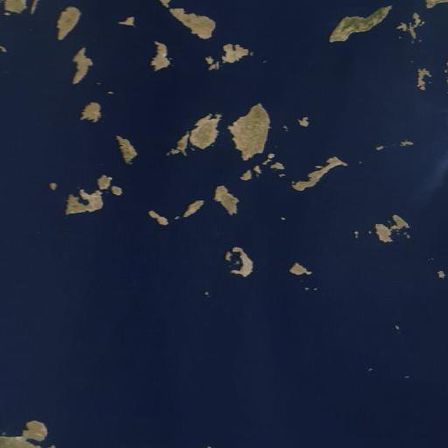


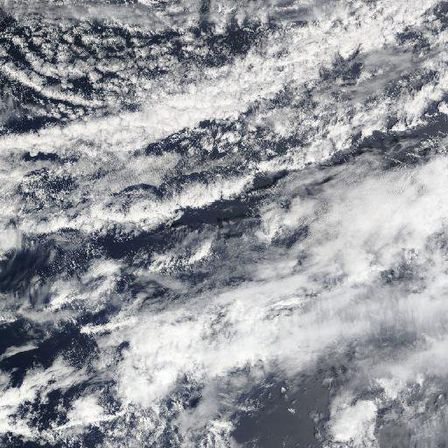

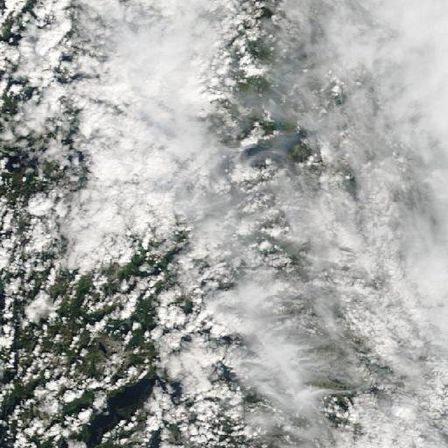
Patch-level inference as flown in our PoC: 144 patches per scene, 6.5 ms each, 0.93 s per full scene on a sub-watt Cortex-M4. Swap the model via OTA for ship detection, wildfires or change detection — no hardware change.
Zero new hardware
Runs on the OBC your satellites already carry — ARM Cortex-M and A class, down to 128 KB of RAM and under one watt. No accelerator board, no integration campaign, no added mass.
Retrofit in orbit
Models are trained on the ground and pushed via over-the-air update — delta-encoded for narrow satellite links. Every compatible satellite launched in the last five years is a deployment target. Nobody else can touch the installed base.
A model catalog that compounds
Cloud screening today; ship detection, wildfire hotspots, change detection tomorrow — same runtime, different model. Every model built for one customer becomes inventory for the next.
03 / Deployment
From signed pilot to filtering in orbit — in weeks.
Pick the mission model
Start from our catalog — cloud screening first — or have a model tuned to your sensor and orbit, trained on open Copernicus data and your own archive.
Deploy over the air
The Laika runtime and model install on your existing flight computer — bench-validated on your OBC image first, then delta-uploaded to satellites on the ground or already in orbit.
Downlink only value
Each scene is scored onboard against your thresholds. Cloudy and redundant frames never touch the radio. €25–40k recovered per satellite per year — or the same budget turned into revenue-bearing capacity.
04 / The alternative
The market sells you a box. We ship you software.
Onboard AI today means dedicated accelerator hardware — capable, but expensive, power-hungry, and structurally unable to reach satellites that are already flying.
| AI accelerator hardware | Laika · software-only | |
|---|---|---|
| Additional hardware cost per satellite | €25,000 – €100,000+ | €0 — uses the existing OBC |
| Power envelope | 3 – 15 W | < 1 W |
| Integration timeline | Months of HW + SW qualification | 1 – 3 months, software only |
| Satellites already in orbit | Cannot be upgraded | Retrofit via OTA update |
| Marginal cost per added satellite | A new hardware unit, every time | Near zero — a software licence |
| New use case mid-mission | Locked at mission design | New model pushed in flight |
HARDWARE FIGURES: PUBLISHED RANGES FOR VPU / DPU / GPU-CLASS ONBOARD AI PAYLOADS IN THE EUROPEAN SMALL-SAT MARKET. A 10-SATELLITE CONSTELLATION RUNNING LAIKA FOR DOWNLINK FILTERING RECOVERS AN ESTIMATED €250–400K PER YEAR.
05 / Proof, not promises
Already running on flight-representative silicon.
END-TO-END CLOUD DETECTION · 95-CLOUD DATASET (LANDSAT-8) · TFLITE MICRO + INT8 POST-TRAINING QUANTISATION · STM32 NUCLEO-L476RG. ROADMAP: RADIATION-TOLERANT ARM AND LEON FLIGHT PROCESSORS.
We're selecting a handful of operators to fly Laika first.
The pilot is software-only: no hardware commitment, no launch dependency, evaluated on your own OBC image. Pilot partners shape the model catalog and lock preferential licensing before general availability.
What pilot partners get
- →Bench validation on your OBC image — see inference running against your sensor data before anything flies.
- →A model tuned to your mission — cloud screening first, or the use case that hurts your downlink most.
- →OTA deployment path to satellites on the ground or already in orbit — weeks, not an integration campaign.
- →Preferential licensing locked for your whole constellation before general availability pricing.
- →Direct line to the founding team — your constraints become the product roadmap.
Evaluations are sequential and engineering-led — cohort closes when slots fill.